Showing posts with label new materialism. Show all posts

Saturday, 3 February 2018

Gullet - Review


for Saatchi Magazine, Spring Issue 2018

Gulletby Julia Crabtree & William Evans & ‘U’: a performance by Rachel Pimm Cell Project Space 17.11.2017 — 21.01.2018


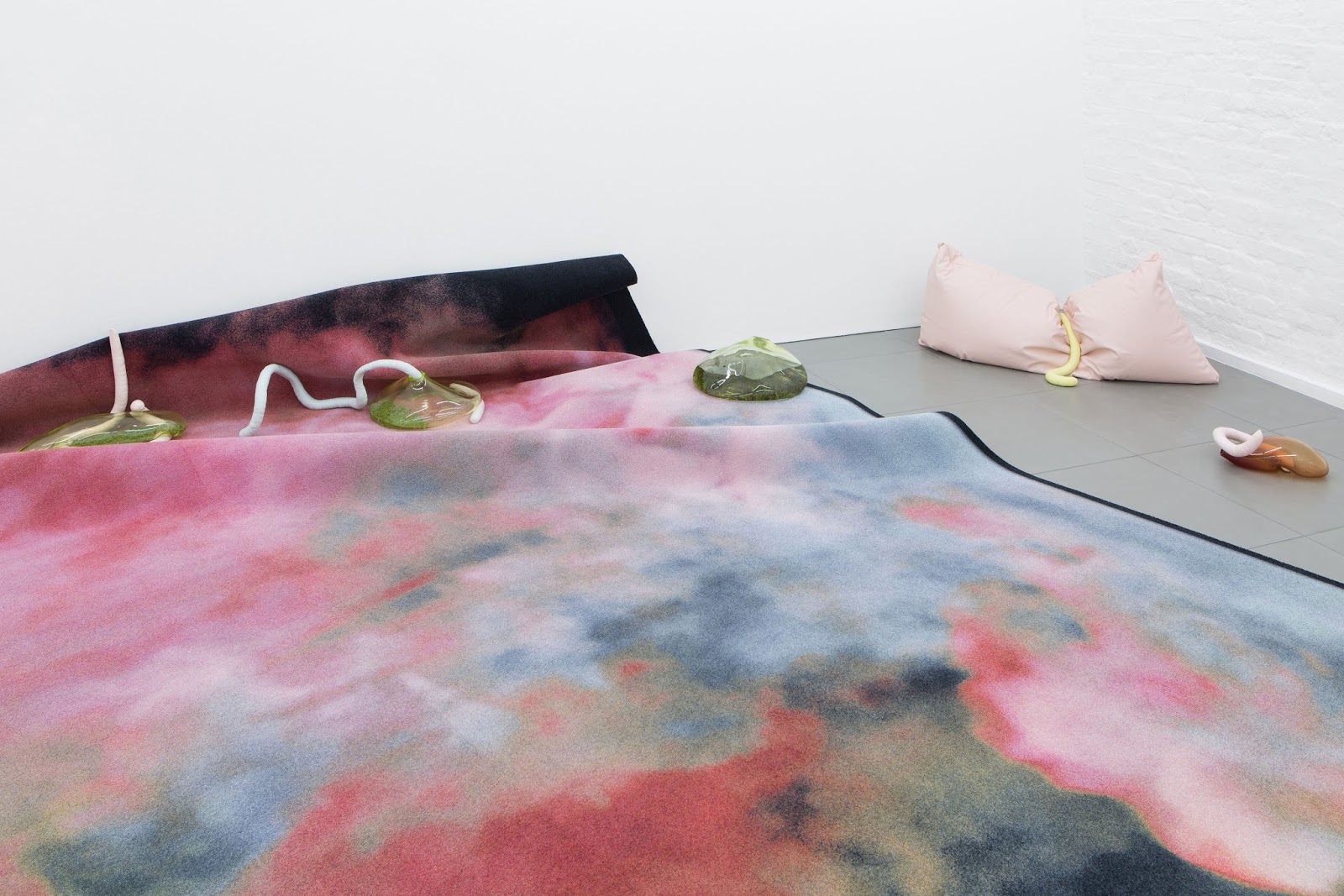
Upon hearing the title for Julia Crabtree and William Evan’s latest show at Cell Project Space, I arrived anticipating the macabre. A black room crammed with pink rinds of flesh and lurid, hypnotic screens; a sculptural endoscopy of sorts. Fortunately, this wasn’t the case. An extension of their long- term collaboration and combined research interests, ‘Gullet’ elides the surgical footage of gastric tissue and mucous which haunts our popular imagery of inner-bodily processes. Instead, by juxtaposing craft, technology and a vibrant materiality, Crabtree and Evans animate the customarily oblique aesthetics of contemporary art with a subtle consideration of mutual affectivity and the collective ecologies of human embodiment.

Augmenting their 2016 show ‘Gulch’ – commissioned by The Banff Centre, Canada – the architecture of Cell Space has similarly been inverted by the inclusion of an abstract, multi-coloured carpet. Taking its aesthetic from digitally rendered smoke, the flat surface evokes the inhuman perception of heat- sensitive surveillance technologies and satellite maps, used as a visual indicator of life or organic activity (as has been brutally displayed in the state-military apparatus of Richard Mosse’s prescient work Incoming). Angled and crammed toward one of two hollow doorframes – taking as their implicit form as Gullet’s pharynx and anus – this macro-vital cartography hosts an array of microbial forms.


The largest of these amoebic bodies are a series of lumpen furnishings mounting each other as they pile through the Gullet’s narrow oesophagus. Reminiscent of the uncanny mattresses shown in Kaari Upson’s latest exhibition at the New Museum, Good thing you are not alone (2017), the nauseating blend of moss green, warm beige and mauve gives the swollen forms a distinct sense of half-chewed, half-digested food matter. Hidden the other side are a loose swarm of parasitic worms, each cast in a pastel jesmonite, twisting and convulsing around one another in an orgy of ravenous anticipation.

The lucky few of these intestinal feeders that have slithered their way into the main space of the gallery find themselves drawn to presence of several clairvoyant glass blobs. Dispersed in the space, drooping from Cell’s natural architecture or bosomed by soft rolls of bare memory foam, several of these molten orbs have been left empty whilst others harbour a multitude of green algae. The morphological bodies of these post-terrarium chambers appear similar to the fluid undulations of brain cell mitochondria, which through a process of self-deformation stretch and connect our various neural pathways – a network of neuroanatomy itself named the vermis, from the etymological root ‘vermi’ - the worm.


Accompanying the exhibition is a performance by Rachel Pimm, an artist familiar with said vermicular genealogies (see her 2015 performance at the Chisenhale Gallery, Worming out of shit). Focusing on the active materiality of Uranium or ‘U’, a spoken word piece follows as the red eye of a Geiger counter traces over the audience’s bodies and Gullet’s strange glass amoebas. In each case the erratic ticks of the counter intensify: the glass has been fired in an old technique containing U, historically used for tinted colouring and ultra-violet illumination.


Constructing a conceptual assemblage of U, from its mining in the Congo and Rwanda, to its forces of evolutionary attraction and its new configuration as a vehicle of planetary annihilation, the address signs off: “U is alien. U, the first and last natural thing on the earth. U came from the stars in a fog of cosmic energy.” Combined with the hybrid ecology of Gullet, the insinuation is clear. You are U: both alien and collective, productive and entropic. Used neither as a bulwark to the bemoaning of symbolic integrity, nor as an avant-garde ‘Return to the Real’, the materiality expressed by Gullet and U is heterogeneous and entangled. It reminds us that we are complex systems; embodied collectivities at once organic and synthetic, molecular and cosmic. 

Wednesday, 13 September 2017

Becoming-Other, Becoming-Slime


In a competition to best optimise Tokyo’s railway network, pitted against a vast team of Japanese experts from the fields of engineering and design, who would you choose to help win the project?

I choose a piece of mould.

Physarum poluycephalum to be precise. This single-celled collective organism — or slime mould — given its favoured environment — dark, wet and concealed from light, with plenty of bacteria and fungal spores to munch on — will ooze and promulgate its dendritic body in a garish, toxic yellow. And whilst possessing absolutely no brain, nervous system or any means of centralised regulatory function, displays a resounding capacity for intelligent behaviour.

The worming blob of cytoplasm grows and extends as individual spores merge from their molecular to molar aggregate through an unpredictable and entirely environmental set of sensory-feedback loops. Through some sense of extracellular spatial-intelligence — “a kind of living hard drive”[1] — individual amoebas are directed toward one another and synergise into an amorphous, unicellular whole. It then engulfs bacteria and other microbiotic prey into its cell membrane and secrets enzymes to digest them.

Physarum, whilst having been previously lumped into the fungal taxonomical camp, has now been classified as a Protist, a special place reserved for those biological anomalies that are at the “odds and ends of the natural world [and] don’t fit in with the rest of our taxonomic grouping system.”[2] Arriving on the Earth a good billion years ago, this slime is perhaps the most resilient and hardy of terrestrial species, coagulating into a hardened sclerotium under adverse environmental factors, or else deploying an army of haploid spores, both of which under more favourable, moist conditions will deliquesce back to its active, plasmodium vitality. In other words… its immortal.

For a few months or so back in the early 2000s, nature and technology columnists were captivated by the work of Japanese researcher Toshiyuki Nakagaki. Along with his team of microbiologists, Nakagaki placed some Poluycephaluminside a labyrinthine structure with some crumbs of oatmeal at different ends. Almost intuitively, and with a precision and speed that most humans would doubtful replicate, the slime mould managed to established the shortest and most efficient tubular network possible from one piece of food to the other, it’s tendrils of protoplasm slithering into dead ends and back out of them, hunting for its meal.

In a second experiment, with the grains placed in the approximate location of Tokyo and its neighbouring 36 towns, the rhizomatic slime produced a cartography remarkably similar to the existing railway network. One which, it has been remarked, unaffected by political biases, could actually be more efficient, cost less, and be more fault-tolerant that the current one. Indeed, the logistical genius of this mould has been extended in similar experiments to road networks in both the United Kingdom and the Iberian Peninsula. 


Even more bizarrely, the mould has shown signs of memory. In a controlled environment, Physarum has been proven to anticipate and react to set-interval environmental changes, and has also been shown to exhibit a rudimentary form of learning called ‘habituation’: upon encountering a bitter but harmless substance in its path to a food source, whilst originally met with hesitation, the slime mould would eventually begin to pour over the substance with increasing determination, forgetting and re-learning this information with different time-frames of exposure. More recently, it has even been used to control robot facial expressions. 

Learning without a brain, storing without a memory, cognition without a thought.

For the last few years, Finnish artist Jenna Setula has spent her time observing and researching this curious specimen. As for all of its primitivism, this alluring slime poses lots of interesting questions for both biological and computational science — the current development of ‘soft robotics’ — robots that function through ‘genetic’ algorithms, adapting and learning through real-time feedback-loops — have been greatly inspired by these decentralised organisms (in fact, a research group based in Japan actually named one of their soft-bodied robots, ‘Slimey’). And it is generally thought that the combination of variable, morphological feedback-systems, coupled with Big Data information-technologies, will be the foreseeable future of artificial intelligence. 


Now, whilst it is quite easy to jump to the recognisable An/Com political considerations of an organism, that through a decentralised, lateral and rhizomatic ‘network’ of nuclei within the aggregate whole, exhibits extraordinary capacities for long-term species perpetuation, meticulous and efficient energy consumption (with further complex nutrition equilibration), and predictive ecological planning. It is important to remember, however, that the current impasses of neoliberal co-optation have led to a jettisoning of such naïve proclamations of messianic technological and deterritorialized affirmation.

Faced with the endless swamp of digital content, the bottom-up structures of ‘hip’ corporations that function through a horizontal ‘collaboration’ of semi-autonomous agents — all responsible and determined to optimise their own intellectual and affective labour — and the increasing hyper-connectivity of life — where the unemployed are told to upload their CV to LinkedIn for better business opportunities, and through which “new geopolitical forms parasitize the traditional geometries of state sovereignty”[3] – it is no wonder that these examples of micro-biology lack a certain political poignancy.

Fortunately, I don’t think that is the point the Sutela is trying to make. 


Her ongoing series on the life-form is centred around the working title Orgs — Organisation, Organism, Orgasm — and hosts an array of petri-dishes, yellow slime, performances and technological charts. One of its latest iterations, taking place last year at the Future Gallery in Berlin, was her work Orbs (2016). Housed in the gallery’s dark and murky basement, three transparent orbs were lit up with infrared tubes, illuminating the tenebrous maze of glass conduits that Setula’s Physarum crawled through. Each orb contained its own individual design, from a 3D model of an early 20th century Japanese charcoal drawing — a supposed map of the limits of anthropocentric knowledge, made by a royal naturalist who collected slime moulds — to an example of blockchain technology and a Holocratic organisational chart.


Even more recently, at the Centre Pompidou last spring, Sutela inhaled some of the slime mould before conducting a peformative reading, as if the organism were hacking and programming her speech itself — a ‘becoming-slime’. In reference to her titular semiotics, she explained the words’ connotative links: “Orgasms may induce a brief loss or weakening of consciousness, la petite mort. According to Professor Nakagaki, by focusing on the level of unconsciousness, we may find clues to the similarities between the information processing of humans and other forms of organic and synthetic life. […] Artificial intelligence has been trapped on the level of consciousness for too long.”


Now, while this may seem like a rather vogue techno-lusting for non-human cognition, I would suggest that Sutela’s sensibility is a little closer to that of Rachel Pimm’s in her 2015 performance at the Chisenhale Gallery, London. In that performance, Pimm, using similar semiotic playfulness, explored the taxonomical etymology of the worm, through an assemblage of agencies from entropic subterranean annelids, to architectures of cerebral activity: “Vermin? Worm. Or Verm? Vermi? Vermis — the Latin worm, the ancient, original worm, or the cerebral neural worm-shaped pathways that carries the sense of what one’s own body is, alongside and in relation to, and touching neighbouring things. Like a direct wormhole to stuff, to other matter.”

Similar to Pimm, Sutela is bringing attention to the other-worldliness of the assemblages and systems of knowledge that humans are always-already enmeshed within. Recent developments in materialist posthuman philosophies have called attention to the myriad ways in which autopoietic, intensive assemblages of species and nonhuman actants co-constitute life. For example, it has been proven that Omega-3 fatty acids help improve human moods, combats stress and depression, and increase female libido. That gut bacteria influence infant brain development, viruses make up about 5% of the human genome, and that quantum mechanics is responsible for a robin’s navigational systems, photosynthesis and all the world’s enzyme systems.

Amongst all of this, the world simply gets weirder and weirder, and the interplay of forces that shape it — human, bacterial, geological, divine — converge and unravel, full of relentless production and bottomless entropy. The ecology of species, bodies and affects, of computers and algorithms, all radically inter-connected and co-dependant. For all of our cosmic dreams of life beyond this earth, perhaps we should start by considering all things alien, right beneath our noses.


[1] Jamie Sutcliffe, ‘Jenna Sutela: Nam-Gut,’ Art Monthly 408 (2017): 31

[2] http://www.bbc.co.uk/nature/19846365

[3] https://frieze.com/article/other-minds

Thursday, 7 April 2016

Interview with Mark Fisher


CM: Hello Mark, the current debate surrounding Accelerationist Aesthetics seem to oscillate between two ostensibly separate formulations – in your opinion, does an Accelerationist aesthetic lies more in a process of ‘cognitive mapping’ – combatting our phenomenological discontinuity within globalised capitalism – or with an affective cartography of the latter, an experience of what it feels like to be a late-capitalist subject?

MF: I think this question points to a difficult problem with the very concept of accelerationist aesthetics. If accelerationism is about the inadequacy of experience as a category, then how is it possible to render accelerationism aesthetically? Cognitive mapping would seem to be compatible with a leftist accelerationism, but the issue here for me is: what is the aesthetic dimension of this process? It can’t be merely an illustration of a set of propositions that can be apprehended cognitively; the aesthetic has to be doing something in its own right.

For me, a leftist accelerationism could be partly about showing how the “experience” of late capitalism is very different from how it is ideologically rendered. That rendering is not something superimposed over experience, after the fact; it is more that experience (and the subject of experience) is first of all ideological. The problem then is how do we deal with what Ray Brassier has called “the myth of experience”. I think this is an experimental problem, and I guess from my point of view the most important task for a left accelerationist aesthetics is to produce and/ or simulate an “experience” that is beyond capitalism. What would a post-capitalist world feel like, and what kind of being would function in it?

Jon Lindblom, a PhD student in Visual Cultures, has done some interesting work on this area. One important emphasis in Jon’s work is on what he calls the drug-tech interface. Thinking about drugs in relation to technology, about drugs as a technology, gives the whole discussion on accelerationist aesthetics an important twist. In common with recent tendencies in my own work, Jon has been thinking about the psychedelic again, and the way the psychedelic opens up different forms of experience, time, etc. I would say that capitalist realism has suppressed the psychedelic – because the idea of a fixed and immutable reality is a kind of super-reification that is incompatible with psychedelics. Psychedelic ‘experience’ is productively paradoxical, in that it de-reifies both ‘experience’ and ‘reality’, both of which come to seem what they are – provisional and plastic.

CM: Many argue that an Accelerationist Aesthetic must utilise the vernacular of late-capitalist imagery in its work – stock, commercial and brand images; digital-rendering and -editing software; sci-fi and cyberpunk visuals, such as from video games and movies; references to contemporary social media trends etc. – presumably anchored in the belief of re-engineering capitalist technologies and tendencies against themselves. Do you agree at all with this sentiment?

MF: Not really. I think this misses the point of the accelerationist critique of capitalism – that capitalism essentially inhibits acceleration, continually reterritorializing on the familiar and the familial. All of the examples you gave have an exhausted quality; they are “futuristic” only in some long-established generic sense – they don’t relate to any plausible future. The whole emphasis on IT and communicative capitalism is a symptom of capitalist exhaustion. That was the future in the 1980s – it isn’t the future any longer, just as Kraftwerk is no longer the future of music. Social media and smartphones have already happened; extrapolating them into or as the future is surely a mistake. This is the point of all my work on hauntology – capitalism increasingly can’t deliver the future, because it arrests the potentials of technological modernity.

CM: Do you think we have seen a clear manifestation of Accelerationist ideas in some contemporary music production? I am thinking here of artists such as Holly Herndon, PC Music, Kode9, Ryoji Ikeda or even someone like FKA Twigs?
MF: To some extent, though I think there has been a slowing of the accelerationist tendencies in music culture. Up till the end of the 1990s, there was a proliferation of new sonic modes, which opened up whole new phase spaces, new terrains which were experienced by the listener in terms of an enjoyable future shock. Kodwo Eshun describes this brilliantly in his talk “Abducted By Audio” http://www.ccru.net/swarm3/3_abducted.htm It’s hard to think of much 21st century music which delivers this future shock in the same way.

CM: Is it possible that the recent ‘return to the body’ in contemporary art production – specifically through a technological lens – could be understood as an Accelerationist critique – in that it attempts to expose the material and affective infrastructures of a fully libidinised capitalism? One which is ubiquitously offered platitudes of dematerialisation?

MF: Yes, it could – but I think the emphasis on “the body” has a tendency to re-incribe a dualism in the attempt to too quickly overcome it. I suppose I would say that the focus on conditions which produce what is ‘experienced’ as embodiment. There isn’t any “natural” form of embodiment: all “experiences” of embodiment are produced by machineries of one kind or another. Which means that “the body” doesn’t exist. There is a material set of receptors and relays, plugged into and potentiated by various virtual and actual machines, but this isn’t the same as “the body”, which can only ever be a reification. So in many ways, I think the same goes for “the body” as for “experience”. The emphasis should be on material and conceptual dismantling of the way in which they are both naturalised/ reified.

Tuesday, 15 March 2016

Interview with Nick Srnicek


CM: Nick, your work is often seen in contrast to more ‘accelerationist’ (in the sense of which I think you now try to distance yourselves) thinkers such as Nick Land and the CCRU, can you briefly explain the disparities the latter and your work?


NS: I think one of the biggest differences is the subject of the accelerative process. For Land in the 1990s (I stopped reading him when he started writing racist stuff), capital was the subject to be accelerated and human consciousness was just a sort of emergent floating element being swept along by the process of capital. The ultimate endpoint there was to recognise our own illusory nature and accept immersion into the flows of capital. For Alex and I, the subject is perhaps more properly deemed reason, in a collective and inhuman sense. This is more Hegelian and Negarastanian than Deleuzian. The labour of the inhuman is a sort of collective boot-strapping process whereby what it means to be human is progressively uncovered and revised throughout history.

CM: In the post-capitalist society you imagine, do you think contemporary technologies such as Bitcoin, blockchain and other cryptocurrencies are good examples of a current technology which could be utilised in a larger scale?

NS: Personally, I think digital currencies have very little to offer. They are basically a renewal of the gold standard in digital form, and the gold standard fell for good reasons. Bringing it back is not a viable or desirable option. Digital currencies will likely keep being useful for marginal economies (black market economies, most obviously), but I don’t see them threatening global currencies in any way. The blockchain is much more interesting though, and from what I know of it, open to some very interesting potentials. I see a place for it in a postcapitalist economy, but I don’t know it well enough to say much with any certainty.

CM: Is your emphasis on the role of ‘cognitive mapping’ as an aesthetic programme concurrent to your political economy – as opposed to a more affective notion of accelerationist aesthetics as championed by Steven Shaviro – in response to what you see as the conceptual immediacy of folk political tendencies, which favour the personal and the affective over the structural and the rational?

NS: It is, to a certain degree. The issue with cognitive mapping is ultimately one of generating a strategy for a collective historical agent. A strategy, by definition, requires a mapping of the terrain of the struggle, along with an understanding of the various forces in play. This is a systemic – and therefore, rational – approach. But it isn’t simply the rejection of affective and aesthetic elements, since they play the mediating role between an abstracted strategy and local instantiations. So cognitive mapping tries to gesture towards the problem of connecting abstracted strategy to localised actions.

CM: Do you think the recent movement of what have been described as ‘New Materialist’ art practices – or more generally, art practices which take dematerialised platforms such as the internet or finance and reinvest them with a more bodily, affective and material nature – could be classed as a form of accelerationist critique? In that they reconfigure abstract, global and complex areas of contemporary capitalism in an attempt to reveal their material infrastructure and bodily affects.

NS: It possibly can, though I’m wary of saying much about contemporary artistic practice since I know so little of it. I think the work of people like Holly Herndon, Kode9, and Ryoji Ikeda are good examples of musical ‘accelerationism’, but in large part because their work doesn’t simply try to instantiate some pre-planned ideas. They’re working with material in new ways and inspired by related ideas, but it’s not ‘accelerationist’ in any simple sense. More part of a broad cultural milieu where these sorts of ideas are percolating and being developed through different media in different ways.

CM: Is there a worry with your emphasis on cognitive mapping, and technological modelling of objects such as the economy or climate change, that this will lead to a form of technological sublime (such as in your example of the software Minksy)?

NS: It definitely could, though in part the aim of modelling is to avoid that problem! It’s increasingly a risk though, as models get more and more complex – particularly in the back-end where all sorts of complex mechanisms and hidden politics go on. One area where you might see something like the technological sublime is when you get machine-learning algorithms that produce convincing results – but without anyone knowing how those results came about. It doesn’t leave people stupefied like normal technological sublime, but it does leave them no more aware of what is actually going on.